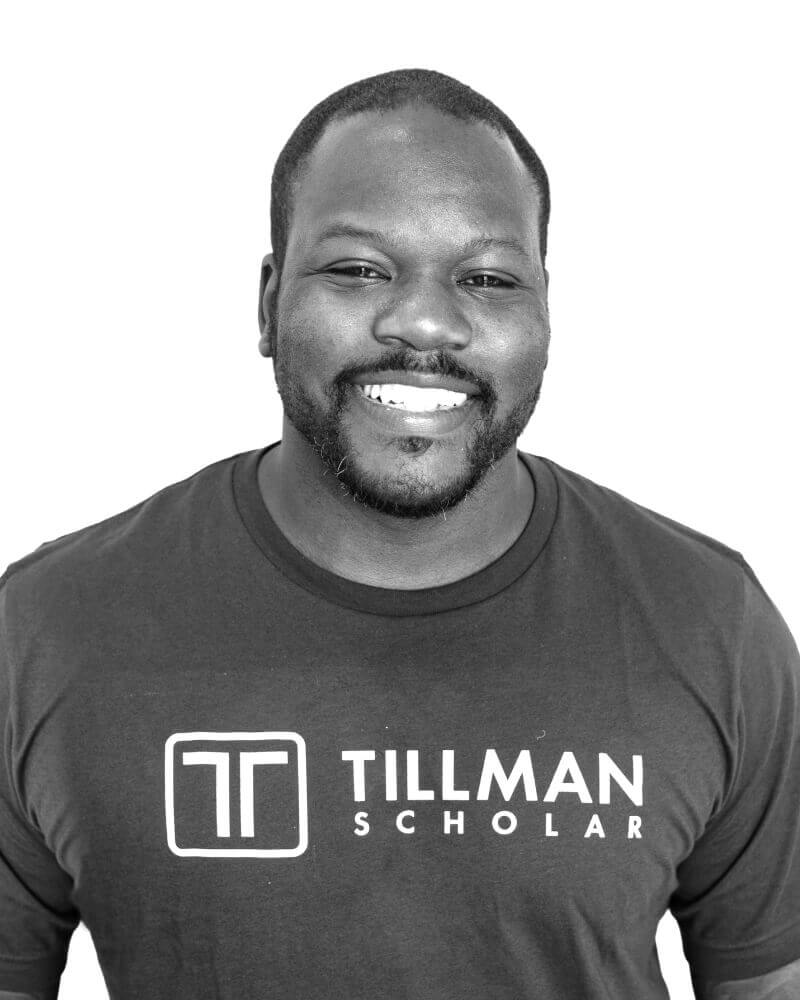
“You don’t need a clear path. You just need the willingness to keep moving.”
A Boy From New Orleans, and the Screen That Opened a World
When Rikeem Sholes was growing up, time outdoors wasn’t a regular part of his early life. It wasn’t until his early 20s, around the time he began working as a biologist, that he started experiencing it more directly.
He grew up in inner-city New Orleans, where access to nature looked different. Much of what he learned came from public television documentaries, and those moments mattered. They mattered deeply. David Attenborough became one of his earliest influences, offering a window into a field he hadn’t yet had the chance to step into himself.
That screen became a starting point. And Rikeem never stopped looking beyond it.
Over time, that curiosity turned into something steadier, a clear sense that biology was the path he wanted to follow. What he needed was the opportunity, and the confidence to pursue it.
The Navy gave him both.
The Navy Raised the Bar, For Everything
Rikeem enlisted in the United States Navy with a dream of becoming a scientist and not much else, no roadmap, no connections in the field, no guarantee that the path would be straightforward. What the Navy gave him was something he could not have found anywhere else: a completely new understanding of what difficulty actually looks like.
“He has been able to transfer skills from making a ship work on deployment with the Navy to making his experiments work in the field as a biologist,” noted a profile by the U.S. Fish and Wildlife Service. “His experience in the military raised the bar of what was ‘difficult’ for him. So even if the days are hard in the field, they are never as hard as they were in the Navy.”
That recalibration, the ability to look at a hard problem in the field and think this is nothing compared to what I’ve already done, is one of the most underrated gifts military service gives people. For Rikeem, it became the quiet engine beneath everything that followed.
When he was discharged, he enrolled at Louisiana State University, pursuing his degree in marine biology. He graduated. And then he went to work, building something that most people don’t have: a career forged entirely by showing up, staying curious, and learning from every single person around him.
Eleven Years of Showing Up for the Natural World
What followed Rikeem’s graduation wasn’t a straight path. It was a journey shaped by curiosity, persistence, and a willingness to go wherever the work needed him.
He worked across environmental agencies, monitoring hatchery fish along the Columbia River and stepping into urgent conservation efforts when it mattered most. On Midway Atoll, he helped respond to a botulism outbreak threatening the endangered Laysan teal, one of just three volunteers who located, treated, and rehabilitated sick birds. Long days, difficult conditions, meaningful work.
And still, he remembers it simply:
“I didn’t have a bad day that whole summer.”
Along the way, he kept learning, from scientists, programmers, anyone willing to share. He earned a Master’s degree from the University of Denver while working full-time, added technical certifications, and taught himself electrical engineering and software development.
He later built a Raspberry Pi–based system to count lamprey across the Pacific Northwest, a solution that ran for months, reduced manual effort, and expanded ecological data in the region.
Over time, his work became something uniquely his own: a blend of field science and technology. Today, he is a licensed drone pilot and fish biologist, finding new ways to study and protect the natural world he once only saw from afar.
The Chance Meeting That Opened the Final Door
In 2020, during a community bike ride, Rikeem met a professor from Washington State University Vancouver, a chance conversation that quietly changed his path. He had been thinking about graduate school but didn’t want to leave the Pacific Northwest. For the first time, staying and going further felt possible.
Not long after, he enrolled in a Ph.D. program, focusing on how hatchery environments shape the sensory development of Chinook salmon, work that sits at the intersection of biology, environment, and long-term conservation.
Around the same time, he was named a Tillman Scholar, becoming the first student from his campus to receive the recognition. It wasn’t a shift in direction. It was a continuation of everything he had been building toward.
Research and a full-time career are not enough for Rikeem. They never have been.
He helps lead a growing community that makes the outdoors more accessible to people who have historically been left out of those spaces. It’s personal. He knows what it feels like to grow up without that access, and what it means to find it later in life.
That same instinct led him to create a project celebrating Black authors, after noticing how often their voices were missing from mainstream spaces. Instead of waiting for that to change, he built something of his own.
Whether in science, community, or culture, the pattern is the same: see what’s missing, and make space for it.
What Rikeem’s Story Leaves Us With
Rikeem’s path was never clearly laid out. What he had instead was curiosity, and the discipline to follow it, even when the way forward wasn’t obvious.
Over time, that curiosity became a career, and that career became something larger: a way of opening doors for others while continuing to walk his own path forward.
His story isn’t about a single breakthrough moment. It’s about showing up, again and again, and building something meaningful, one step at a time.